Signing
How does one sign a painting correctly? Bottom left, bottom right? In small or large script? In capitals? Are initials sufficient, or should it be a monogram? Should the signature appear on the surface of the painting at all — or does it rather estrange the work? Perhaps better only on the reverse? And is it even still contemporary to sign at all?
These questions are by no means new. They concern not only art historians in the clarification of provenance and authorship, but naturally also the artist himself, who understands himself as the father of his works. To answer the question of the proper signum, the following applies for me: listen to the work! It communicates with you.
With this awareness, I attempted from the very beginning of my studies to develop a language of signing that is omnipresent, yet does not assert itself in an attention-seeking manner. For this reason, from the outset I used textual fragments within the image that are virtually predestined to replace the expected text with my name. These fragments sometimes also contain the complete metadata of the work.
Over time, it was then the differing painterly modes themselves that dictated to me how they wished to be informed of my authorship. Thus, in the field of classical painting I chose a Kurrent script. Since I have always admired Russian realist painting — notably that of the Wanderers movement (Rus. Peredvižniki) — it was natural to establish a Cyrillic signature as well.
There are works in which I simply rendered my surname in Cyrillic, which appears as Фридрихъ (translit. Fridrichʺ). As this seemed neither particularly East Slavic nor aesthetically convincing — despite my attempts to approximate it as closely as possible to Repin’s handwriting style — I ultimately decided on a translation of my name into a Slavic variety. Since my name is meaningful, this was not difficult: Friedrich = Old High German frid (“peace”, “protection”) + rîhhi (“mighty”, “ruler”, “realm”). These components can readily be translated by calque.
The first variant to emerge from this was Миробагачук (translit. Myrobahačuk), composed of Proto-Slavic mirъ (“peace”) and Ukrainian bahat- (“rich”), with the ending -uk emphasising the Ukrainianness of the name. For the Russian form Миробогатовъ (translit. Mirobogatovʺ), the etymology is similar; here the ending is simply replaced by the Russian -ov. Both signatures therefore appear, motivated by theme and geographically differentiated, in my Ukrainian and Russian pictorial worlds. Where the linguistic sphere opens into Polish, the Proto-Slavic commonalities also allow, playfully, a Polish variety to be developed as Mirobogaczyk — whereby the endings -czyk/-čuk, as in Ukrainian, carry both patronymic and diminutive connotations.
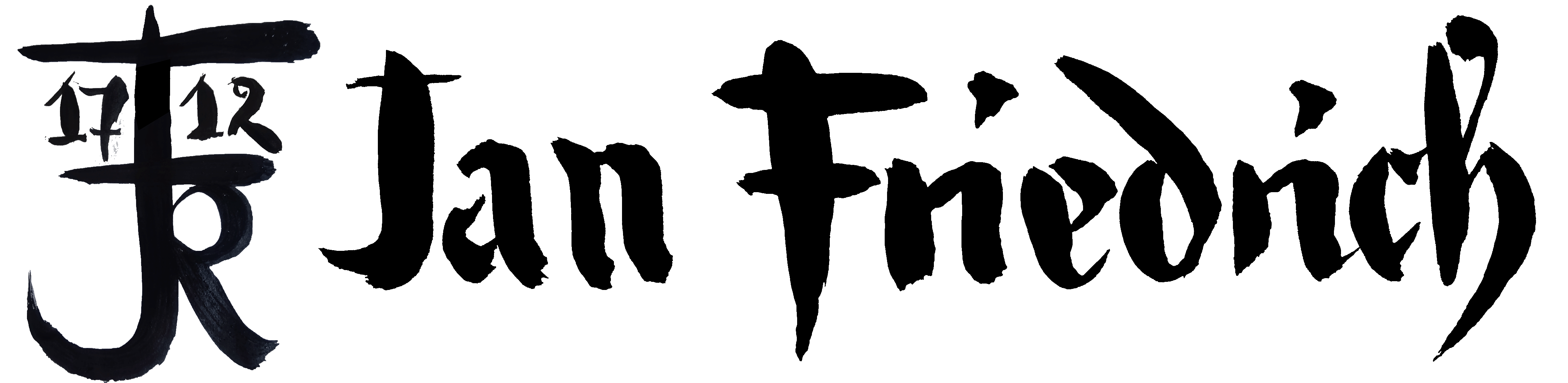
Certain subjects, by contrast, suggested the development of a Czech equivalent as well, which, owing to the kinship of the name with Smetana, could be resolved differently: in this particular case I was able simply to make use of his Bohemicised given name Bedřich (“Friedrich”). When I move within a linguistic sphere foreign to me, I rely on transcription — that is, the phonetic equivalent of my name in the respective writing system — which explains the Chinese signatures. And if all these elaborations still fail to answer the call of the work appropriately, I employ my monogram — the crux Friderici — composed of my initials together with the tongue-in-cheek apposition Rex, to which 1712 likewise refers.